


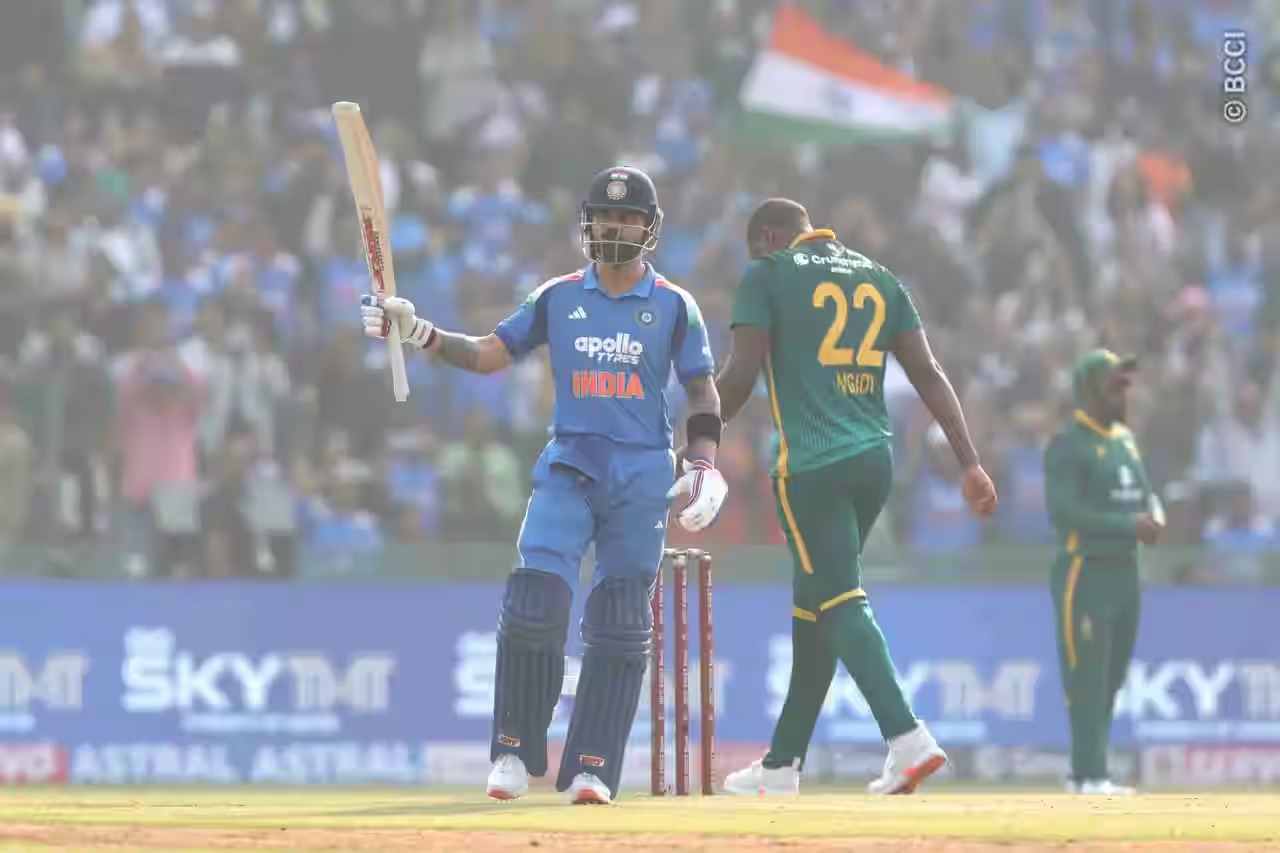
Two topics dominate modern cricket chatter:
· Does Virat Kohli still have it?
· Should batters show “intent” from ball one? Yesterday’s Kohli century quietly and efficiently, answered both.
Hunger and Fitness: The Kohli Combination
The punch in the air after reaching his hundred said enough.
The quick turns after every run said more.
And the 111 run-made runs (not boundary-made) out of his 237 across two ODIs sealed the argument.
In an age where T20 power-hitting has reduced the art of strike rotation to an endangered species, Kohli continues to treat every run like it deserves personal attention. Two centuries in consecutive innings while travelling non-stop?
Fitness questions can now take the next exit.
Intent: Cricket’s Most Misunderstood Word
Few words in cricket have been misused as gloriously as “intent.”
Coaches, commentators, journalists – we’ve all thrown it around like confetti.
But intent doesn’t mean trying to hit every ball into the next postcode.
It means moving the game forward, scoring off what you can, rotating strike when you can’t, and refusing to clog the scoreboard with dots.
Kohli made only 40 of his 102 in boundaries; Ruturaj Gaikwad made 60 of his 105.
Their 195-run partnership wasn’t powered by fireworks, it was powered by cricketing sense.
They hit what deserved to be hit and ran for everything else.
To any young batter watching: intent isn’t violence. It’s awareness.
Don’t let anyone tell you that a mistimed slog equals bravery.
Did India Lose Because of Kohli’s 102 off 93?
Short answer: No.
Long answer: Absolutely not.
Yet somehow, dew, misfields and leg-side freebies don’t make the blame list. Kohli does.
Let’s pretend for a moment that Kohli was indeed the culprit.
When he got out, India were 284/4 in 39.1 overs.
South Africa at the same stage?
267/3 – 17 runs behind.
India scored 74 runs off the last 65 balls, losing two wickets.
South Africa scored 95 off 61 balls to finish the job, losing three wickets.
So where did the game actually shift?
In India’s innings, 22 balls from KL Rahul, Washington Sundar and Ravindra Jadeja produced no runs, many of them hoicks that found only air.
Convert even half of those dots into singles and the series might have looked very different.
Meanwhile, Corbin Bosch and Keshav Maharaj did what intelligent batters do when the equation is in their favour: they took singles, respected the field, and didn’t try to audition for the next IPL mega-auction.
Because, again, intent isn’t drama – it’s decision-making.
The Kohli Effect
Kohli continues to do what he has done for more than a decade: show up, score runs, let the bat speak, and walk back to his quiet corner while the noise surrounds him.
As for the naysayers, they’ll find something new to complain about tomorrow.
Consistency, after all, is important.

For more updates on the IND vs SA series, follow RevSportz