




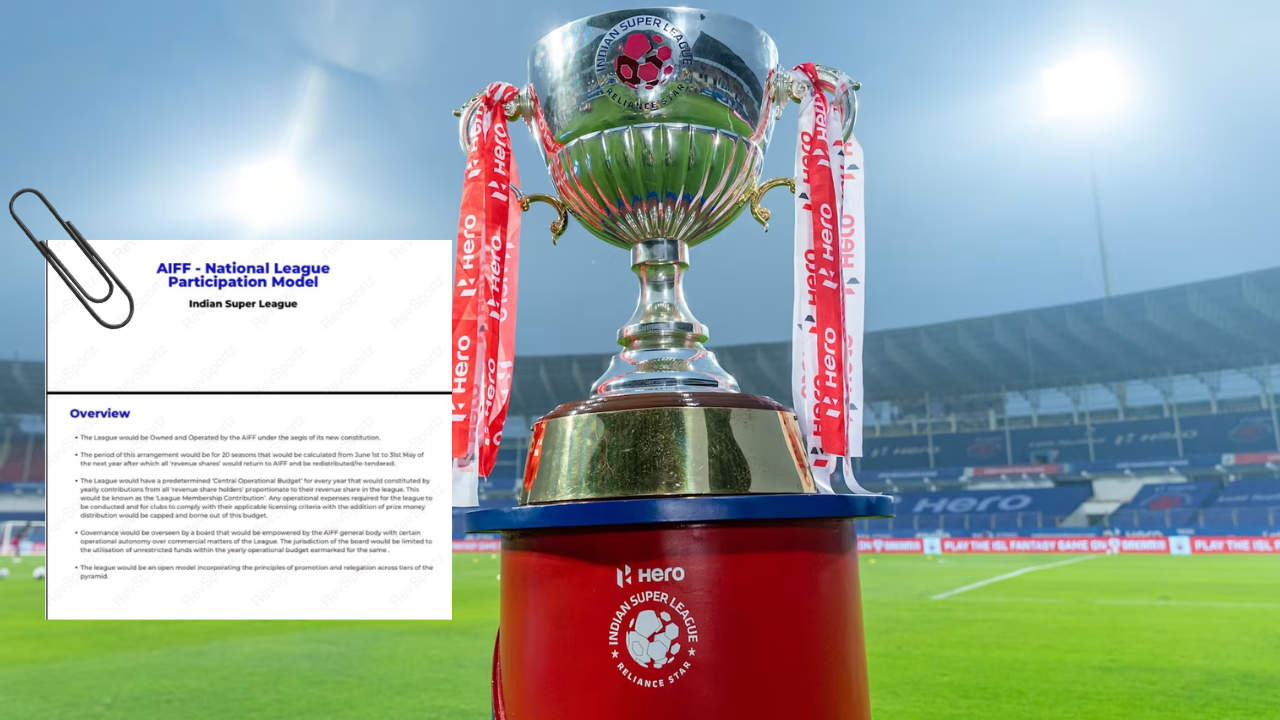

In a significant step toward resolving the uncertainty surrounding the future of the Indian Super League, the All India Football Federation has presented a detailed long-term proposal before the clubs, outlining a new governance, operational and financial structure for the league. The proposal was presented during a meeting convened to address concerns raised by clubs over the lack of clarity in the league’s future roadmap.
Under the proposed model, the ISL would be owned and operated by the AIFF for a 20-year period, with each season running from June 1 to May 31. At the end of this cycle, all revenue shares would revert to the federation and be restructured or re-tendered as deemed appropriate. The league would continue to function as an open system, maintaining promotion and relegation across tiers.
A key component of the proposal is the creation of a Central Operational Budget, which would govern the league’s functioning every season. For the first year, this budget has been pegged at Rs 70 crore. The amount would be funded through proportional contributions from all revenue shareholders and used to cover operational expenses, licensing requirements and prize money. Importantly, an additional operational provision of Rs 1 crore per club has been proposed to support day-to-day league-related expenses and compliance costs.
BREAKING
AIFF proposes a new ‘Open Model’ for the league:
✅ Promotion & Relegation is BACK
✅ 20-season long-term blueprint
✅ 50% Revenue share for Clubs
✅ Parachute payments for relegated sides ️#IndianFootball #AIFF #ISL pic.twitter.com/7lC2KTtvtK
— RevSportz Global (@RevSportzGlobal) December 26, 2025
The governance model envisages a board empowered by the AIFF General Body, with autonomy limited to managing operational and commercial matters within the approved budget. While decision-making authority would rest with this board, the AIFF would retain overall oversight.
Financially, the proposal outlines a structured revenue-sharing mechanism. A commercial partner would be required to invest Rs 12 crore to acquire an additional four per cent revenue share, taking its total holding to 30 per cent. The AIFF would retain a 14 per cent share, while the remaining revenue would be distributed among participating clubs. Any surplus generated after recovering the Rs 70 crore operational budget would be redistributed in accordance with predefined ratios.
The plan also seeks to safeguard long-term club investments. Clubs with longer participation histories would be entitled to retain a fixed revenue share even if relegated, provided they continue to meet their financial obligations. Depending on the duration of their participation, clubs could retain between 0.25 per cent and 1 per cent of fixed revenue share. Additionally, two per cent of the central pool has been earmarked as parachute payments for relegated teams.
Under the proposed structure, 60 per cent of total revenues would remain with the AIFF, of which 10 per cent would be retained directly and 50 per cent distributed equally among participating clubs as part of their membership entitlement. The remaining 40 per cent would form the fixed revenue pool for commercial partners and long-term investors.
Clubs, however, have raised concerns regarding operational expenditure, salary regulations and the long-term security of their investments. These points, along with clarity on the proposed financial framework, are expected to be discussed in greater detail when the AIFF and club representatives reconvene on December 29.
The proposal marks the most comprehensive attempt yet to provide a stable, long-term structure for Indian football. Whether it satisfies club stakeholders and leads to consensus remains to be seen, but the coming discussions are likely to shape the future direction of the ISL.
For More Football Stories Follow RevSportz