


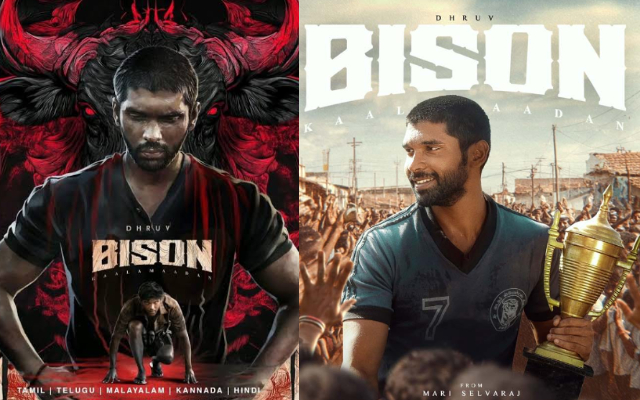
Bison Kaalamaadan is not designed to entertain in the conventional sense. It confronts, unsettles, and occasionally exhausts the viewer — much like the sport it places at its core. Mari Selvaraj’s film, now streaming on Netflix, is a reminder that the most powerful sports stories are rarely glossy or comfortable. Anchored by an extraordinarily restrained performance from Dhruv Vikram — who smiles just once in the entire film — Bison Kaalamaadan emerges as one of the most honest sports films Indian cinema has produced, and perhaps the most authentic representation of kabaddi ever put on screen.
At one level, this is the story of a village youngster rising through the unforgiving world of kabaddi to achieve international glory. But Selvaraj is not interested in the familiar underdog template. Kabaddi here is not a vehicle for montage-driven triumph or motivational speeches. It is survival. Breath, bone, instinct and pain. The camera does not aestheticise the sport; it immerses itself in it. The mat feels abrasive, the tackles feel punishing, and every raid carries a sense of real consequence. In doing so, Bison Kaalamaadan does more for kabaddi than years of league branding, federation initiatives or broadcaster-driven marketing campaigns.
Modern kabaddi has been packaged aggressively — floodlights, coloured mats, dramatic music, statistical overlays and manufactured rivalries. While this approach expanded reach, it also distanced the sport from its origins. Selvaraj’s film reverses that drift. He strips kabaddi down to its elemental core, reconnecting it to the communities and conditions that birthed it. Mud replaces polish. Scars replace statistics. Fear replaces spectacle. The result is not just authenticity, but renewed respect. The viewer does not “consume” kabaddi here; they experience it viscerally.
This rawness is where the film’s marketing power lies. Bison Kaalamaadan never tries to sell the sport. It makes you feel why it matters. No campaign slogan or broadcast innovation could communicate kabaddi’s primal appeal as effectively as these sequences do. The film reminds us that sport does not need to be dressed up to be compelling — it needs to be told truthfully.
Selvaraj places this sporting journey against the backdrop of brutal gang warfare in Thoothukudi and surrounding southern Tamil Nadu districts. The violence on the kabaddi mat mirrors the violence of the streets, creating a powerful parallel between physical combat in sport and social survival outside it. Kabaddi becomes both refuge and resistance — a structured outlet for aggression in a world where chaos and oppression are ever-present. This is where the film becomes unmistakably Selvaraj’s: political without being didactic, angry without losing empathy.
The director takes deliberate creative license in pitching the protagonist’s rise to international glory, culminating in India’s victory over Pakistan for kabaddi gold at the Hiroshima Asian Games. This is not played as chest-thumping nationalism. Instead, the triumph feels intimate and hard-earned — a personal liberation rather than a national spectacle.
Dhruv Vikram’s performance is central to the film’s impact. He plays the role with clenched restraint — eyes burning, jaw set, emotions tightly coiled. The near-total absence of overt expression reinforces the idea of a man who has no space for softness in a hostile world. When that single smile finally appears, it lands with quiet devastation, carrying the emotional weight of the entire film.
Bison Kaalamaadan is not polished, comfortable or universally pleasing. It is raw, gory, political and deeply empathetic. For sports lovers, it is essential viewing — not just as a film, but as a lesson in how sport should be represented.

For More Exciting Articles: Follow RevSportz