



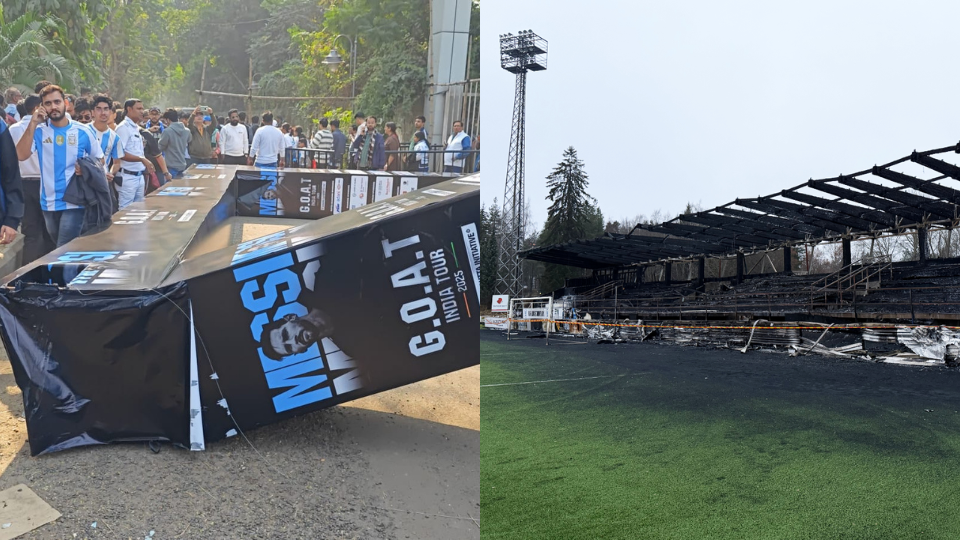
Over the last 24 hours, the talk of the town has been the chaos at Vivekananda Yubabharati Krirangan (VYBK) during Lionel Messi’s ‘GOAT Tour of India’ event. After the organisers failed to meet spectator expectations, the Argentine superstar — along with his Inter Miami teammates Luis Suárez and Rodrigo De Paul — left the stadium after a brief 15‑minute VISIT. What followed was disorder and unrest inside the venue.
During this period, Messi was largely surrounded by local politicians, their social media teams, security personnel and photographers, with little visible coordination or crowd management. Fans, who had paid thousands of rupees for tickets, felt cheated, and as Messi left the stadium, boos and angry chants echoed across the stands. Hoardings were torn down, and soon the pitch was invaded by furious spectators. Vandalism followed — seats were uprooted and hurled onto the field, goalposts were damaged, and within an hour, parts of VYBK were left in ruins.
Fans are, and must always remain, central to any sporting ecosystem. While the GOAT Tour was not a competitive event and was a privately organised gala, it still involved the emotions of thousands who bought high-priced tickets for a glimpse of their idol. Instead, fans were arguably the most neglected stakeholders, while VIPs and dignitaries got unrestricted access to the Argentine legend. That sense of exclusion and betrayal fuelled the anger, and matters soon spiralled out of control.
Over time, world sport has witnessed several such mishaps — some caused by vandalism and fan violence, others by poor planning, administrative failure or intense rivalries. Tragedies like the Hillsborough disaster or the Royal Challengers Bengaluru trophy parade stampede serve as grim reminders of how mismanaged events can lead to loss of life. There have also been instances where play had to be halted due to crowd unrest, such as the infamous India vs Pakistan Test at Eden Gardens in 1999, which had to be stopped and the final day was played in front of empty stands.
Listed below are some recent examples of vandalism and crowd-related incidents in football:
FC Haka, Finland (December 2025)
The Finnish second-division side finished 12th in the league and were relegated. Following the drop, a group of teenage supporters reportedly set fire to one of the stands at the Tehtaan Kenttä Stadium. A wooden stand and parts of the pitch were damaged, forcing the club to seek crowdfunding support for repairs.
Kanjuruhan Stadium tragedy, Malang, Indonesia (October 2022)
A league match between Arema FC and arch-rivals Persebaya Surabaya ended in a 3-2 defeat for the home side. After the final whistle, Arema supporters invaded the pitch, triggering chaos. Police responded by firing tear gas, while exit gates became choke points for fleeing fans. According to official reports, at least 125 people —including children — lost their lives in one of football’s deadliest disasters.
The Wembley Disorder, London (July 2021)
During the Euro 2020 final between England and Italy, more than 2,000 ticketless spectators — many reportedly under the influence of alcohol or drugs — forced their way into Wembley Stadium. Several were injured in the mayhem, and the incident was later described as a “national day of shame” by British authorities. The events were documented in the Netflix series The Final: Attack on Wembley.
These incidents underline a recurring lesson: without proper planning, crowd control and respect for supporters, even the grandest events can descend into chaos.

For more such stories, follow RevSportz