


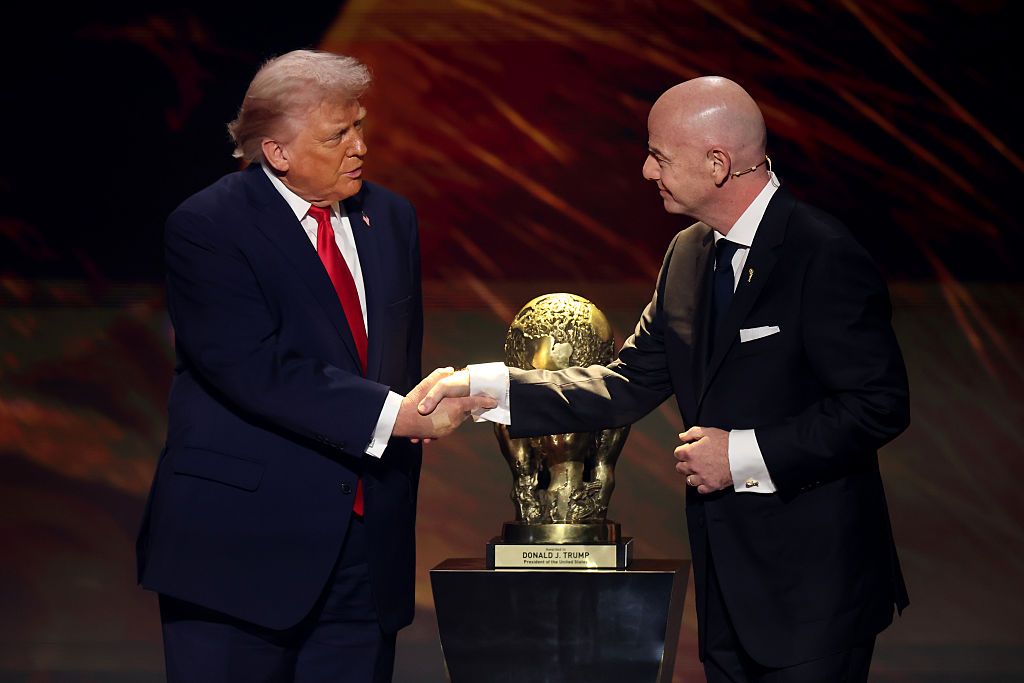
The World Cup has always been more than just football. It is a celebration of culture, a showcase of national pride, and a gathering of humanity at its most exuberant. Yet the unveiling of the 2026 World Cup draw on Saturday, alongside the awarding of FIFA’s inaugural Peace Prize to Donald J. Trump, offers a stark reflection of how modern sport is increasingly shaped by political spectacle.
The 2026 tournament, spanning the United States, Canada, and Mexico, will be the biggest in history: 48 nations, 12 groups of four teams each, and a globally calibrated schedule designed for maximum prime-time viewership. The expansion, and the evolving draw format combining competitive balance with brand-building spectacle, underlines that football today is not just a game but a meticulously engineered entertainment system.
The draw divided teams into four “pots” to seed groups, with each pot contributing one team per group to balance strength, confederation representation, and fairness. The hosts, Mexico, Canada, and the United States, were pre-assigned to Groups A, B, and D respectively. Still, some groups stand out as far more demanding than others, and with the new format (top two teams plus the best third-placed teams advancing), surprises may well be in store.
Group F, featuring the Netherlands, Japan, Tunisia, and a play-off winner, is widely considered among the toughest. The average FIFA world ranking of its participants places it as one of the most demanding groups in the draw.
Group I, with France, Senegal, Norway, and a play-off qualifier, also appears brutal on paper, challenging the assumption that established powers will cruise through the group stage. For teams drawn into such groups, survival will require not just talent but near-perfect preparation, mental resilience, and the ability to treat every match as a final.
Group C, headed by Brazil and joined by Morocco, Scotland, and Haiti, blends star power, rising challengers, and underdog momentum. Brazil remain favourites, but the margin for slip-ups is slim.
Group D, featuring the United States, Australia, Paraguay, and a European play-off winner, seems comparatively favourable for the hosts. The absence of historically dominant European or South American powers offers a smoother potential path to the knockout rounds.
The shift from 32 to 48 teams expands access, but raises questions about consistency, fairness, and how match-ups may skew perceptions of “easy” versus “hard” draws. The expanded format, with a larger knockout field (top two plus best third-placed teams), offers hope for underdogs and creates space for upsets. Yet it also dilutes the clarity of group-stage “survival”, making every match, even those against perceived minnows, critical.
There is a clear opportunity for emerging nations and global football development. More qualification slots across Africa, Asia, and smaller confederations mean the sport continues to grow more global and less Euro-centric, driving investment in infrastructure, youth development, and national football cultures in countries that previously had little chance to compete.
This edition brings plenty to watch: Will underdog nations, perhaps newcomers from Africa or Asia, use the 2026 platform to push beyond the group stage? Can elite teams avoid complacency in groups where third-place advancement is possible, and will that alter tactical approaches? Will match quality remain high, or will “padding matches” against weaker sides affect engagement and tournament prestige? How will the expanded format influence travel fatigue and preparation across multiple host nations with varied climates? And, in the long run, will this edition shift the balance of power in world football, making it more unpredictable, more global, and more competitive?
Also Read Groups and match-ups revealed for game-changing FIFA World Cup 2026
Follow Revsportz for latest sports news