


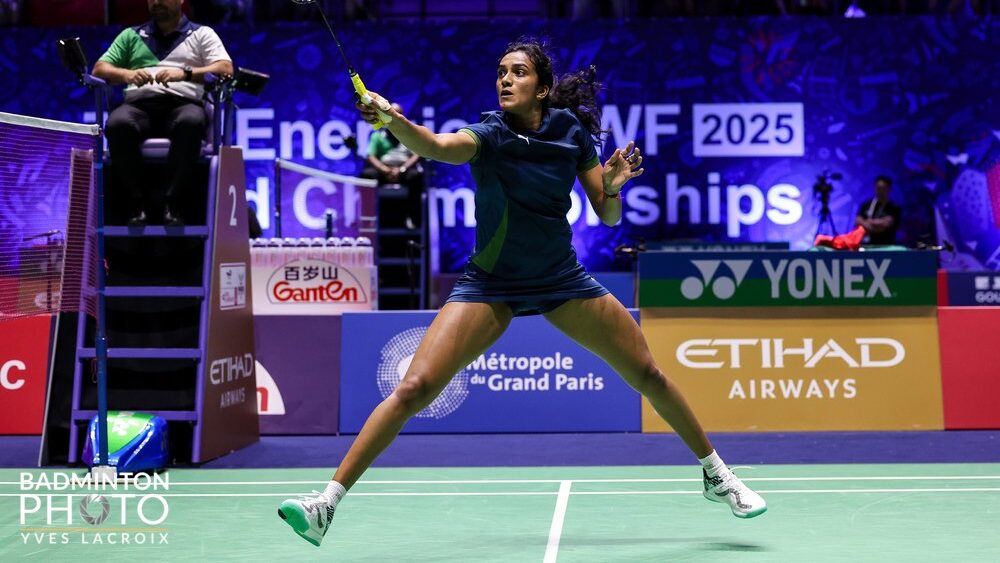
Few Indian athletes embody longevity, resilience, and global relevance quite like P.V. Sindhu. For over more than a decade at the elite level, Sindhu has experienced every phase of an elite sporting career: meteoric rise, sustained dominance, global validation, physical setbacks, and now, a carefully calibrated pause. Her journey offers a compelling lens through which to examine not only her own achievements, but also how extraordinarily difficult it is for women athletes to make comebacks at the highest international level.
P. V. Sindhu’s career milestones read like a blueprint of Indian badminton’s rise on the global stage. From announcing herself with a World Championships bronze in 2013, to redefining possibility with an Olympic silver at Rio 2016, Sindhu steadily converted promise into pedigree. The crowning moment came in 2019 when she became the first Indian to win gold at the BWF World Championships, elevating her from elite contender to global champion.
The Tokyo Olympics in 2021 added another historic layer, as she secured bronze to become the first Indian woman with two individual Olympic medals. This was followed by the long-awaited Commonwealth Games singles gold in 2022, completing a rare full set of major honours. Across three Olympic cycles, multiple world-tour titles, and sustained presence among the world’s best, her milestones are not just markers of success but evidence of consistency at a level Indian badminton had rarely witnessed before her era. At the Paris Olympics in 2024, she exited in the Round of 16 — a result that, while short of the podium, still marked her third Olympic campaign, a rarity in singles badminton.
In 2025, a persistent foot injury forced a difficult but telling decision: Sindhu ended her season early to prioritise recovery over rankings. For elite athletes, this choice is rarely about weakness; it is about self-awareness. At this stage of her career, every injury carries compounded risk. Recovery is no longer just about healing tissue. It is about restoring confidence, biomechanics, and match readiness.
This pause highlights one of the central truths of elite women’s sport: comebacks are rarely linear. Time away means lost ranking points, tougher draws, and reduced margin for error. Returning athletes are often forced to play higher-ranked opponents earlier, making momentum harder to build.
There are also systemic challenges. Ranking systems rarely account fully for long recovery phases. Sponsorships and support structures, though improved, still demand performance validation. The sport itself evolves rapidly; the game Sindhu dominated in 2019 is faster, flatter, and more relentless today. A comeback, therefore, requires not just recovery, but reinvention.
Viewed as a timeline, Sindhu’s career moves through distinct phases: prodigy, champion, legacy athlete, and now strategist. What her career uniquely teaches us is that excellence at the global level is not built on early success alone, but on the willingness to continuously re-engineer oneself. Sindhu’s journey shows emerging badminton talent that medals are milestones, not destinations. She did not dominate by being the most naturally gifted or the most stylistically elegant player of her era; she thrived by embracing physical robustness, mental resilience, and professional discipline over long Olympic cycles.
Her career underlines a crucial lesson for young athletes: the world’s best are not defined by uninterrupted peaks, but by how intelligently they manage injuries, form slumps, and evolving competition. In an era obsessed with instant success, Sindhu’s longevity offers a counter-narrative — that patience, structured planning, and self-awareness are as valuable as talent.
Follow Revsportz for latest sports news