





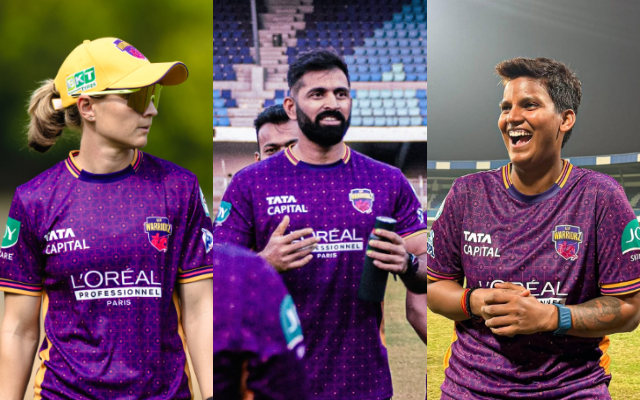
History is not kind to teams that stumble early in the Women’s Premier League. In WPL, no side losing its first three matches has clawed its way back into the playoffs. That statistic hangs heavily over UP Warriors as they walk into their fourth game, against the defending champions, a resurgent Mumbai Indians.
Mumbai, after a sluggish start, have found rhythm and purpose. The turnaround has been led by skipper Harmanpreet Kaur, with decisive contributions from Nat Sciver-Brunt, Amanjot Kaur, and the breakout performer – as many insiders had predicted – Nicola Carey.
UP Warriors, meanwhile, are not short on talent. What they are short on is clarity.
A new coach in Abhishek Nayar, a new captain in Meg Lanning, and yet the results and more importantly, the decisions, have consistently backfired.
Decision 1: Entering the Auction Without a Specialist Wicketkeeper
It started before a ball was bowled. UP Warriors’ decision to skip a specialist wicketkeeper at the auction raised eyebrows. The explanation, a “KL Rahul-style” flexibility, sounded innovative. In practice, it became restrictive.
With Shweta Sehrawat taking the gloves, UPW boxed themselves into selection compulsions. Sehrawat had to play, not because of form, but because there was no viable alternative apart from Shipra Giri, whose batting reliability remains uncertain.
Sehrawat impressed in the opening game. Since then, returns have been modest. The larger issue, however, is not her form, it is the lack of flexibility her enforced presence creates.
Decision 2: Disrupting the Opening Combination After One Narrow Loss
Losing the first match by just ten runs should have encouraged continuity. Instead, UP Warriors panicked.
The opening pair was shuffled from Kiran Navgire–Lanning to Harleen Deol–Lanning. That move revealed a deeper concern: uncertainty over player roles.
Navgire is not a floating batter. She is not a No. 4. She is a powerplay specialist, full stop. If she plays, she opens. Asking her to adapt elsewhere negates her primary value.
Form issues aside, role clarity is non-negotiable in T20 cricket. UP Warriors have violated that principle repeatedly.
Decision 3: Making Phoebe Litchfield Carry an Entire Batting Unit
With Navgire struggling, Lanning batting scratchily, and Deol requiring time to settle, the scoring burden has fallen squarely on Phoebe Litchfield.
At this point, Litchfield is not just batting, she is firefighting. She knows acceleration is expected, that the middle order lacks momentum, and that collapse is always around the corner. The result? Forced shots, rushed decisions, and scores that stall around the 20–25-run mark.
UPW have inadvertently turned one of the most elegant young batters in the game into a pressure valve.
Decision 4: Retiring Out Harleen Deol on a Difficult DY Patil Pitch
If there was one moment that summed up UP Warriors’ confusion, it came against Delhi Capitals at DY Patil Stadium.
On a slow, tricky surface, Lanning and Deol fought through tough conditions. Deol, often criticised, played with discipline and awareness. When Lanning fell, logic dictated one thing: protect the set batter.
Instead, UP Warriors retired Deol out who was on 47 off 36 balls.
The decision was baffling. On that pitch, a new batter was never going to dominate immediately. The move backfired instantly, draining stability from the innings and triggering collapse.
Decision 5: Ignoring Deepti Sharma as a Finisher
After Chloe Tryon’s brief stay, the obvious next batter was Deepti Sharma.
Instead, UP Warriors sent in Asha Sobhana Joy, a decision that defied both form and logic. Deepti’s power-hitting credentials over the last year are well documented. To suggest she cannot clear the ropes is to ignore modern evidence.
Once again, resources existed. They simply weren’t used.
Decision 6: Bowling Deepti Sharma Only After 14 Overs
Then came the moment that left even seasoned observers searching for explanations.
Why did Deepti Sharma bowl her first over in the 15th?
Was she injured? Was there a tactical plan? Or was it simply the fear of Shafali Verma?
If the answer is match-up anxiety, then UP Warriors have a bigger problem. Deepti Sharma is a world-class bowler, World Cup-winning, battle-tested, and tactically astute. She is the highest wicket taker in WT20Is. If she cannot be trusted in pressure overs, the question must be asked: why is she in the XI at all?
Used low in the batting order. Delayed with the ball. Deepti Sharma, one of the most valuable all-rounders in world cricket, is being systematically underutilised.
A Team Fighting Itself
This UP Warriors side is not short on skill. It is short on conviction.
What we are witnessing is not a team losing to opponents, it is a team losing to indecision. Tactical confusion, reactive planning, and unclear roles have created a side constantly second-guessing itself.
Can Abhishek Nayar and Meg Lanning engineer a turnaround? Theoretically, yes. Five matches remain. Mumbai Indians, despite their form, are not invincible.
But before UP Warriors can challenge Mumbai, they must first confront themselves.
Until they resolve the chaos in decision-making, strategy, and role definition, UP Warriors will continue to battle internally, long before the opposition even enters the contest.
Tonight, they face Mumbai Indians.
The real question is simpler, and far more urgent:
Can UP Warriors finally stop fighting themselves?


For more updates, follow REVSPORTZ,