






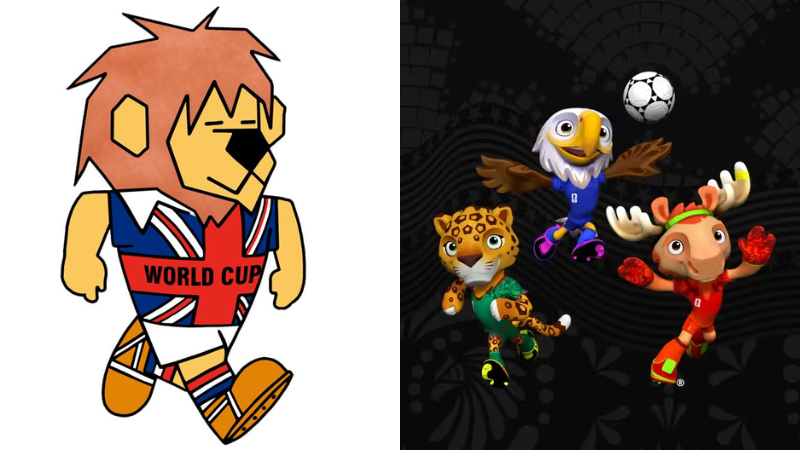
Over the decades, we’ve seen some iconic mascots in the top sporting events. When it comes to the FIFA World Cup, it is no different. The tradition started way back in 1966 England, as Willie, the Lion, was the first ever FIFA World Cup mascot. It was designed by Reg Hoye, a children’s book illustrator. Since then, every four years, as football fans across the globe wait for the showpiece event, mascots also hold a special value in the scenario.
Mascots hold a significant value when it comes to any such sporting events. They represent the culture, their flora and fauna, language, and much more. Generally, the mascots are anthropomorphic characters, designed in children friendly manners, with colours and symbols representing the host country.
When it comes to FIFA World Cups, we’ve seen some iconic mascots over the years. For instance, 1982 Spain’s Naranjito, or in recent years, 2010 South Africa’s Zakumi, were fan favourites. When it comes to the Olympic Games, mascots are a symbol of achievement, and each medallist is awarded a replica, along with their medals.
In the upcoming FIFA World Cup 2026, to be hosted in three countries — the United States of America, Canada and Mexico — it’s obvious that there will be three mascots, representing three host nations. Maple the Moose, representing Canada; Zayu the Jaguar, representing Mexico and Clutch the Bald Eagle, representing USA.
Maple the Moose, is an anthropomorphic Canadian moose, who is a goalkeeper, wearing a red jersey, like Canada’s. The name is inspired by the maple leaf, Canada’s national symbol.
Zayu the Jaguar, originates from the jungles of southern Mexico and is a striker, who is wearing the Mexico green jersey. America’s most powerful cat, the Jaguar has been a symbol of strength and spirituality in Mexican culture for more than three thousand years.
Clutch the Bald Eagle, is an American Bald Eagle, who plays as a midfielder, and wears the USA blue jersey. The Bald Eagle is the national bird of the United States and symbolises freedom, strength and patriotism.
ALSO READ: FIFA World Cup 2026 – Group H Preview: Spain, Uruguay, Saudi Arabia and Cape Verde
Let’s take a look at the other World Cup mascots over the years.
1996, England — Willie, the Lion, the national symbol of the United Kingdom, wearing a Union Jack, with the words written, ‘WORLD CUP’.
1970, Mexico — Juanito, the young boy wearing the Mexico kit, with the words, ‘MEXICO 70’.
1974, West Germany — Tip and Tap, two boys wearing the German kit, with the letters ‘WC 70’ (Weltmeisterschaft, World Cup)
1978, Argentina — Gauchito, a boy wearing the Argentina kit along with the attires of a typical gaucho.
1982, Spain — Naranjito, the Orange in the Spanish jersey.
1986, Mexico — Pique, the jalapeño pepper with a moustache, wearing a sombrero.
1990, Italy — Ciao, the only World Cup mascot without a face. It’s a ticket figure in the Italian tri-colour, playing football.
1994, United States — Striker, a dog in the USA’s red, white and blue jersey, with the words ‘USA 94’
1998, France — Footix, the iconic French cockerel with the words FRANCE 98 written on its chest.
2002, South Korea & Japan — Ato, Kaz and Nik. Futuristic computer-generated characters. Together they were the members of a fictional team called ‘Atomsball’, with Ato being the coach and the other two as players.
2006, Germany — Goleo VI and Pillie. Goleo, the lion’s name comes from ‘Goal’ and ‘Leo’, the Latin for lion, and Pillie the football’s name is the colloquial term for football.
2010, South Africa — Zakumi, the South African leopard. It was perhaps the most celebrated mascot, which gained popularity across the globe. The name comes from ‘ZA’ — for South Africa, and ‘Kumi’ which means ‘Ten’ in multiple African languages.
2014, Brazil — Fuleco, the Brazilian three-banded armadillo in the Brazil shirt, with the words ‘Brasil 2014’ written. The three-banded armadillo is an endangered species in the country, and was selected as the mascot to increase awareness among the people.
2018, Russia — Zabivaka, is a wolf in the Russian kits, whose name translates to ‘The Goalscorer’.
2022, Qatar — La’eeb, one of the few non-animal mascots. The name means ‘Super-Skilled Player’, and is a humanoid ghutrah (the traditional headdress worn by men in the Middle East).
ALSO READ: FIFA World Cup 2026 Group C: What to expect — in detail


For more updates on the FIFA World Cup 2026, follow RevSportz