







Modern cricket stadiums are increasingly being judged not only by the quality of their pitches or the size of their crowds, but by something far less visible and far more consequential: how intelligently they manage water. In an era of climate volatility and urban water stress, stadium sustainability has shifted from a feel-good add-on to a core measure of governance.
Globally, the direction of travel is clear. The best-run venues no longer ask how much water cricket consumes, but what kind of water is being used, and how much of it is recycled, harvested, or substituted away from potable supply. The contrast between international exemplars and Indian stadiums is instructive, not accusatory.
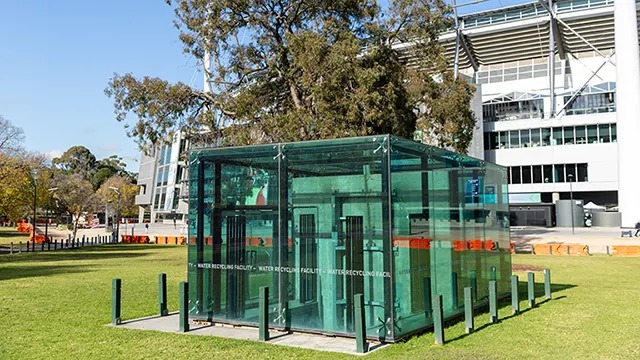
Australia offers the most data-driven benchmark. The Melbourne Cricket Ground publicly states that its on-site water recycling systems generate over 180 million litres of recycled water annually, cutting potable water use by roughly 50 per cent. Recycled water is used not just for turf irrigation but also for toilet flushing and cleaning, supported by large rainwater tanks and water-efficient fixtures. The philosophy is systemic: potable water is the last resort, not the default. This approach has been shaped by decades of drought planning, regulation, and a civic culture that treats water efficiency as non-negotiable.
England sits slightly differently on the disclosure spectrum. Venues such as Lord’s Cricket Ground do not always publish raw annual consumption figures in litres, but they do release audited sustainability and impact reports that track percentage reductions in water use, efficiency gains, and estate-wide improvements. The emphasis is on trajectory and accountability rather than headline numbers, but the governance architecture — monitoring, auditing, and reporting — is firmly in place.
India, by comparison, is still transitioning from intent to institution. Many major stadiums now have rainwater harvesting systems, some have sewage treatment plants, and others are exploring treated-wastewater tie-ups with municipal utilities. Yet hard, standardised public data remains scarce, often surfacing only when environmental regulators or courts demand disclosures.
Where India has made notable progress is in engineering interventions, particularly around drainage and water recovery. Research published in the International Journal of Innovative Research in Technology documents how advanced subsurface drainage systems using underground aeration, vacuum suction, and automated sensors can evacuate excess rainwater rapidly and channel it back into collection systems for reuse.
At Bengaluru’s Chinnaswamy Stadium, such a system was installed at a cost of approximately ₹4.25 crore, involving nearly 4.5 kilometres of piping, enabling the ground to become playable within 30 minutes of heavy rainfall while recycling extracted water back into the stadium’s rainwater harvesting infrastructure . The environmental benefit is twofold: fewer match abandonments and a closed-loop approach to rainwater management.
Popular sustainability assessments of cricket venues echo this engineering logic. Modern “eco-friendly” stadiums are increasingly defined by three levers: rainwater harvesting, recycled wastewater usage, and smart irrigation. Outfields and pitches are among the largest water consumers, but sensor-driven irrigation, soil-moisture testing, and night-time watering can significantly reduce losses due to evaporation. Drainage systems, traditionally seen only as rain-delay solutions, are now being reframed as water-recovery assets. It’s a subtle but important shift in thinking.
The deeper issue for India is not the absence of solutions, but the lack of comparability and transparency. A stadium drawing 300,000 litres on a match day may be far more sustainable than one using half that amount if the former relies largely on recycled and harvested water. Without source-wise disclosure — potable versus non-potable, groundwater versus treated supply — the public debate remains superficial.
Cricket has always evolved with its times, from uncovered pitches to floodlights, from five-day Tests to franchise leagues. Water stewardship is simply the next frontier. The real marker of progress will not be how green a stadium looks on television, but how convincingly it can say: this game was played without draining tomorrow’s water.