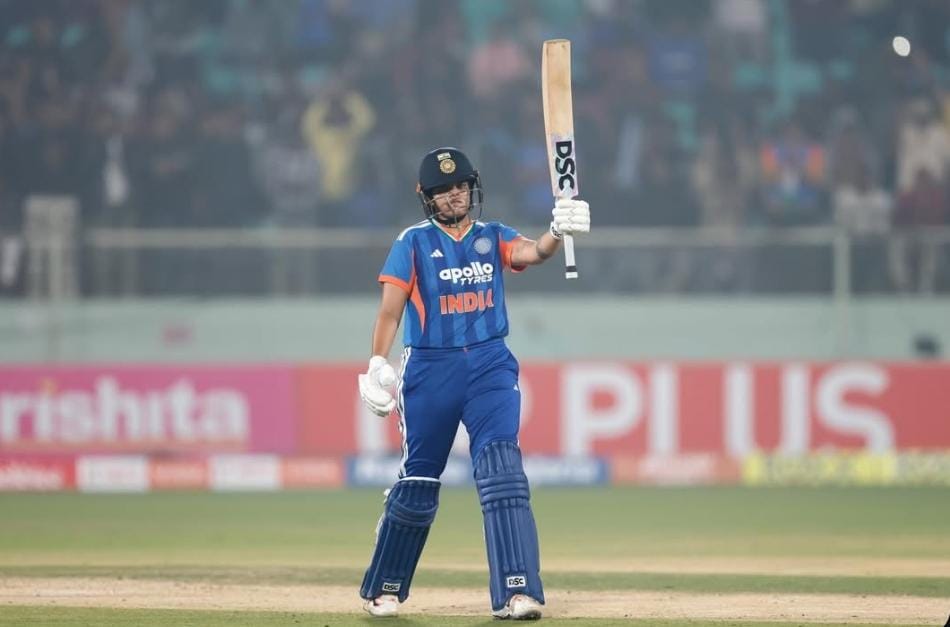
Shafali Verma (Pc- official Instagram handle of Shefali Verma)
In any sport, time away from the field often helps players, especially those who break into the international circuit very early, to reset, understand their strengths, and work on their weaknesses. Shafali Verma being dropped and then making a comeback is a recent and telling example of this.
Nobody has ever doubted Shafali’s talent. But it is one thing to be talented and quite another to consistently deliver on the biggest stage. Shafali’s cameos were not ineffective because of quality, but because of quantity. The 20-40 run zone became a familiar exit point. She was striking at 130 and above, the momentum was positive while she was at the crease, but one shot too many often pulled her into trouble. It turned into a frustrating loop.
It was difficult to imagine, when Shafali made her debut, that there would come a Women’s ODI World Cup squad where she would not even make the reserves. In hindsight, it was a selection error, yes, but Shafali’s tendency to get out after getting set did not help her case. The narrative was hard to escape.
An unfortunate injury to Pratika Rawal, however, opened a door. The new selection panel led by Amita Sharma took a bold call, bringing Shafali in for the semi-final and final matches. Shafali responded emphatically, winning the Player of the Match in the World Cup final. That innings changed several conversations in women’s cricket.
Yet, heading into this series, the central question remained: has Shafali truly changed?
The second and third T20Is have delivered a clear answer. Thankfully for India, that answer is a resounding yes.
Shafali is still striking at 150-180, but now there is caution blended with aggression. She herself spoke about this shift in mindset in a BCCI video after the previous game, where Player of the Match Renuka Singh Thakur was seen interacting with her. Renuka asked, laughing, “They brought an off-spinner in the first over itself, what was going on in your mind? How did you play three dot balls to an off-spinner?”
Anyone familiar with the old Shafali Verma would understand why Renuka’s question hit home. Shafali traditionally attacked off-spinners from ball one, a habit that often led to her downfall, not waiting, not assessing, but trying to dominate every delivery.
Shafali 2.0 smiled and explained: “There were cracks in the pitch, so initially I felt the ball might skid and come back in. I wanted to watch one or two balls and see how it behaved.” She then added jokingly, “Abhi teri behen dekhne lagi hai ek do ball.”
That line, said in jest, captures the transformation perfectly.
This evolution is one the Indian team will welcome wholeheartedly and one that opponents will certainly be wary of. In the previous game, Shafali also went past Mithali Raj to become the fourth-highest run-getter in women’s T20Is for India. Age is firmly on her side, and if this template continues, it will not be long before she challenges the very top of the record books.
The question now is simple: can she sustain it?
Can 2026 become the year of Shafali Verma?
With the next T20 World Cup scheduled in England, the coming year could be career-defining. If Shafali continues to marry intent with intelligence, women’s cricket may be witnessing the arrival of a far more dangerous version of an already explosive talent.