


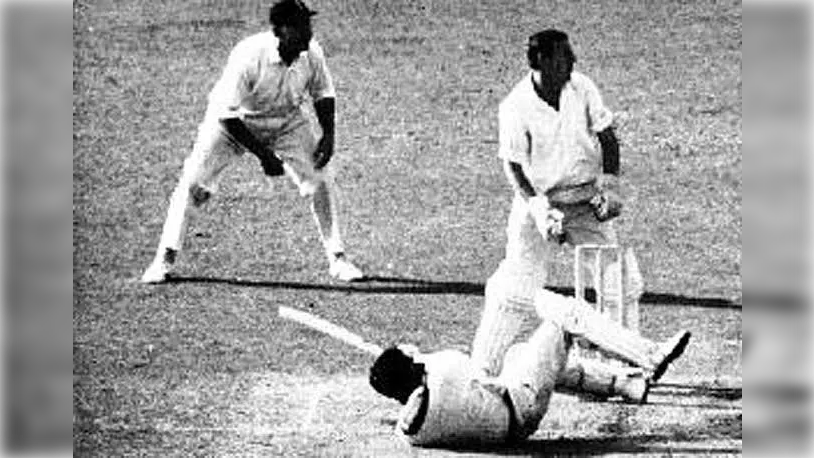

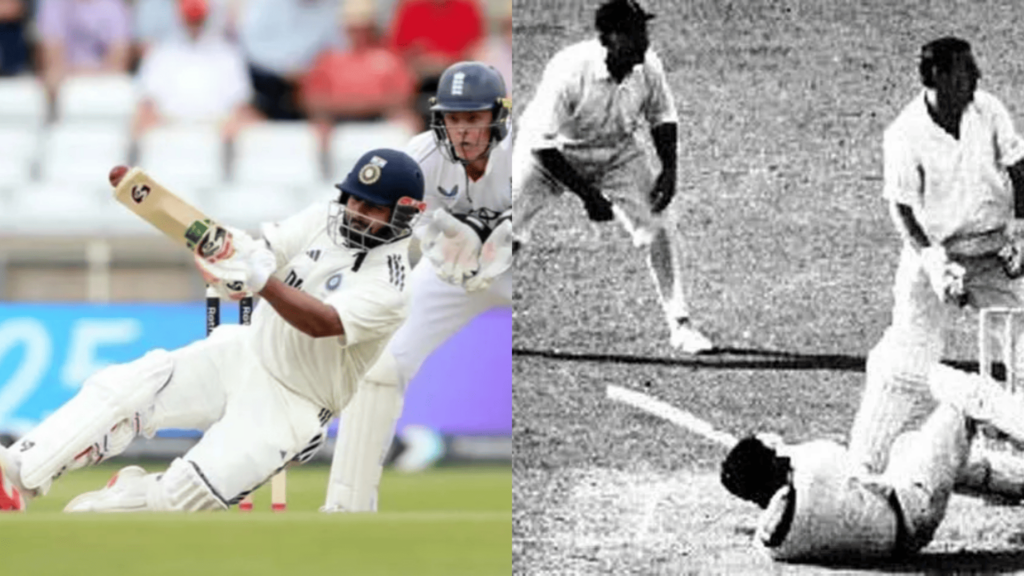
A few weeks ago, I was watching some random cricket highlights on YouTube and came across Rishabh Pant toppling over while playing that one-handed pull or swat over mid-wicket. I knew I had seen something like this before and that got me going. As I randomly searched multiple videos, I realised that back in his day none other than Rohan Kanhai would do the same — move across the stumps and sweep the ball while losing balance, often falling away after contact. Only thing is that he would do this against genuine fast bowling and this was in fact born out of necessity on fast, bouncy pitches with minimal protection. One could perhaps think of this as controlled chaos where survival mixes with audacity.
And I filed this away for this day. Today, December 26 is the birthday of the great West Indian batsman Rohan Kanhai.
Rohan Kanhai had one of the most distinctive careers in cricket history, defined by style, timing, and transition. Many factors made his journey truly unique. Kanhai is immortalised for the “falling sweep shot” — a stroke played while moving across the stumps, often off the back foot, sometimes even while losing balance. It was unorthodox, risky, and aesthetically breathtaking. More importantly, it expanded the vocabulary of Caribbean batting, showing that flair and effectiveness could coexist at the highest level.
Kanhai’s career sat at a historical crossroads — he emerged when West Indies cricket was still finding its identity and peaked just before the rise of the dominant pace-battery era (Holding, Roberts, Garner, Croft). He was the last great West Indies batter before bowlers took centre stage, and in many ways, he carried the batting legacy forward until Viv Richards exploded onto the scene.
Kanhai captained the West Indies during the late 1960s, a period marked by internal transition, inconsistent results and limited fast-bowling depth compared to what would follow
Yet, under his leadership, West Indies won their first Test series in England (1966) — a landmark moment that reshaped Caribbean cricket’s self-belief. That series is often seen as the psychological turning point before West Indies’ global dominance.
Unlike textbook greats, Kanhai didn’t rely on classical balance or stillness. His game was built on hand-eye coordination, anticipation, and courage. This made him a nightmare for bowlers on lively pitches and a role model for future Caribbean greats who played by instinct rather than the manual. Across 79 Tests (1957-1974), he scored over 6,200 runs at a time when batting was far tougher, on uncovered pitches, with minimal protective gear, and against hostile bowling. He evolved from a flamboyant stroke-maker into a responsible senior bat, anchoring innings when needed.
Kanhai mattered not just statistically, but symbolically. He embodied Caribbean confidence, flair, and individuality. He helped establish the idea that West Indies cricket didn’t need to imitate England or Australia, It could define its own rhythm and identity, much like what Kapil Dev did for India.
In essence, if Garfield Sobers was West Indies’ all-round genius and Viv Richards its swaggering emperor, Rohan Kanhai was the artistic revolutionary — the man who proved that freedom, flair, and fearlessness could thrive in Test cricket. His uniqueness lies not just in what he achieved, but in how he taught the world to watch West Indies cricket differently.


Follow Revsportz for latest sports news