


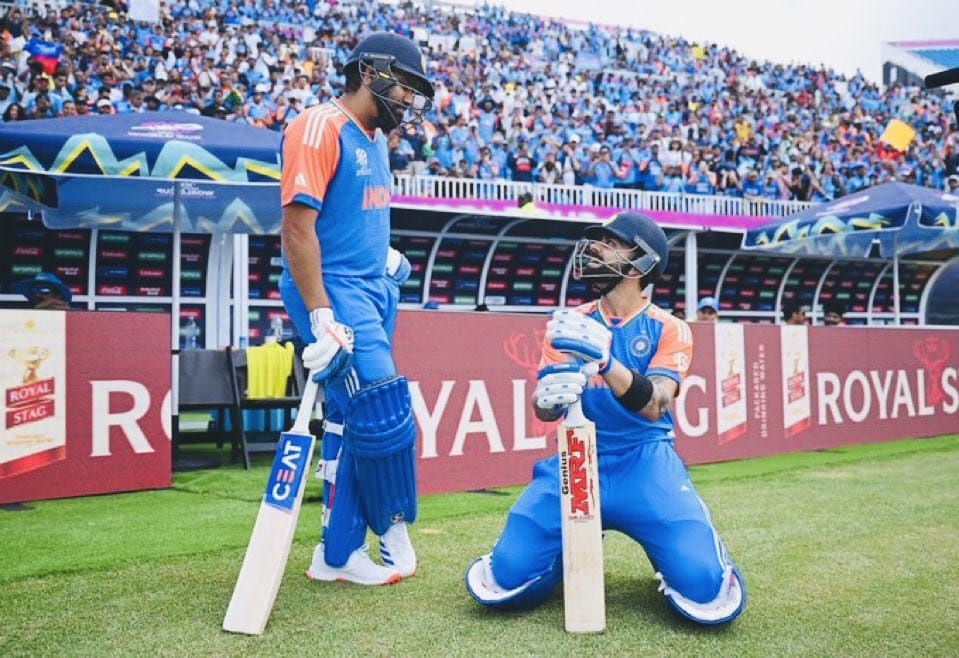
In June 2024, after India won the much-awaited T20 World Cup, Rohit Sharma and Virat Kohli revealed on air that fans had just witnessed the duo’s final T20I appearance. Already teary-eyed while celebrating the win that Indian cricket fans had been longing for, they also marked the end of a long and illustrious chapter in their celebrated careers.
Then, in March 2025, in the midst of Indian Premier League (IPL) action, Rohit – out of the blue – announced his retirement from Test cricket on social media, only weeks before India’s five-match Test tour of England. Just as fans were beginning to absorb the news of the former captain hanging up his boots, Kohli too bid adieu to the longest format of the game within the span of a week – one that he loved and respected more than any other.
That left fans with only one format in which they could still see Kohli and Rohit in Indian colours. Following the Champions Trophy, after a months-long break, the two returned for India’s white-ball tour of Australia. What might have been an inconsequential ODI series instantly became a blockbuster the moment India announced their squad with the names Virat Kohli and Rohit Sharma included. Ticket sales skyrocketed, selling out in hours or days. The same effect was seen back home for South Africa’s tour of India.
In Ranchi, Kohli arrived two days earlier than the rest of the squad to acclimatise to conditions and get his “prep work done”, as he revealed in the post-match presentation of the first ODI. Fans thronged the airport, the practice sessions, and even the front of MS Dhoni’s residence for hours, knowing Kohli would almost certainly visit. The match turned into a paisa-vasool affair even before the second innings began. Kohli scored his 83rd century in front of a packed JSCA Stadium, which included a 136-run partnership with Rohit that elicited the loudest cheers for every single, double, boundary, and maximum.
We are living in an era where audiences are fragmented, attention spans are shorter than ever, and T20I matches are easier to consume as bite-sized entertainment. But Ro-Ko have a way of transforming every bilateral series into an event – their presence restores a sense of occasion. ODI cricket needs giants like Rohit and Kohli. Their star power brings an emotion and nostalgia that only a handful in cricket history have ever evoked.
The proof lies in the way broadcasters market these series, often spotlighting the duo more than even the Indian captain. When they walk onto the field, stadiums fill, broadcasters lean in, and casual viewers tune back in to 50-over cricket. They give ODIs relevance, gravity, and a magic that is increasingly rare.