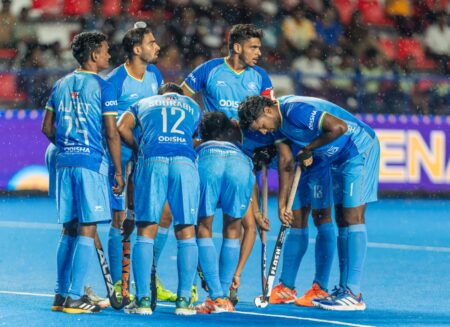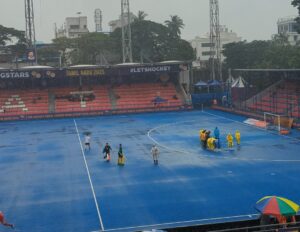





When I landed at the airport for the Men’s Junior Hockey World Cup 2025, a cold breezy drizzle was Chennai’s first hello. Rain followed me on the way to the stadium. A support staff member told me this would continue for the next few days. He was referring to Cyclone Ditwah, which hit Tamil Nadu’s coastal city around the start of the tournament and significantly affected match conditions, player tactics, and the flow of the entire World Cup.
In the group stages, a few matches were played under steady rain and some were postponed. New Zealand vs Japan was one such example. Play was halted for more than an hour during this Pool C match due to a heavy downpour, and support staff took time to clear the waterlogged patches on the turf. Chile’s captain, after another rain-affected match, noted that the pitch had too much water and passing the ball became difficult.
The cyclone’s impact was seen in the stands as well. The stadium, revamped before the tournament with proper roofing, still saw fans struggle to reach the venue due to waterlogging in parts of the city. This wasn’t a major issue during India’s matches, which were played in front of near-full houses, but other games saw notably low attendance as many didn’t want to venture out in the rain.
The slowing turf: a tactical headache for teams
Persistent heavy rain from the cyclone and its remnants turned the blue turf at Mayor Radhakrishnan Hockey Stadium into a slow, heavy surface. This became a tactical headache for teams, as several matches were halted due to showers and, once restarted, long-range passes became harder to execute with the ball slowing down. Teams switched to short, controlled passing on several occasions.
Aerial receptions became difficult as well. While attempting to collect long aerial passes, water droplets driven by the wind came directly into players’ eyes, making clean execution tricky.
The most critical challenges emerged during penalty corner routines. India’s match against Oman was played in steady rain, exposing this vulnerability of the turf.


The heavy downpour slowed the injection and trapping process, leading to sloppy stops and forcing drag-flickers like Sharda Nand Tiwari to rush their shots. India scored 17 goals in that match but converted only 4 of 19 penalty corners against Oman. This remains a concern for P.R. Sreejesh’s coaching staff, a serious warning ahead of the quarter-final against Belgium, especially with skipper and drag-flicker Rohit Ekka struggling throughout the tournament.


For all sports updates, follow Revsportz