


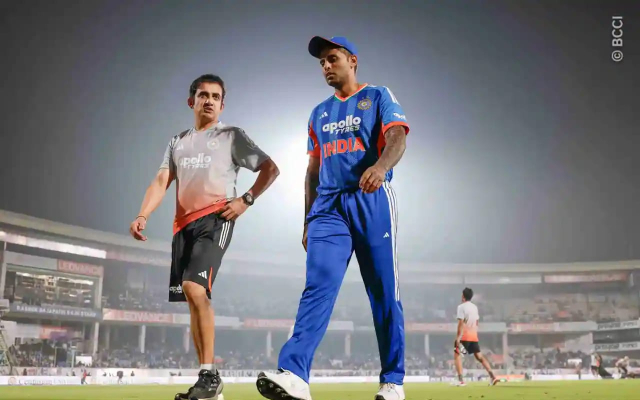
India and New Zealand have faced each other in four T20Is in the final leg of the white-ball series. With the first match of the T20 World Cup less than a fortnight away, India would want to lock in their best XI. They cruised to victory in the first three T20Is of the series owing to some blockbuster performances, especially from the bat, chasing down totals of 208 and 153 in 15.2 overs and 10 overs respectively.
When we look at the top order, quite naturally, Abhishek Sharma is the standout. His exploits from the get-go, coupled with his fearless and ultra-aggressive approach, have given India fiery starts. His opening partner, Sanju Samson, however, has failed to have a similar impact, registering scores of 10 (7), 6 (5), 0 (1) and 24 (15), raising questions about his form ahead of the all-important marquee event. His footwork and technique have been under fire from experts and have been touted as the reasons for his failures with the bat.
On the other hand, Ishan Kishan, who found himself in the playing XI in the first three fixtures of the T20I series owing to an injury to Tilak Varma, has grabbed the opportunity by the throat. He has racked up significant scores of 76 (32), at a strike-rate of 237.5, and 28 (13) in the two opportunities presented to him. His red-hot form has left a lingering question: how do you drop Kishan in this form? While Samson has the management’s faith, many believe it is Kishan who deserves to be slotted into the opening spot alongside Abhishek.
While the move may look like finding a missing puzzle piece on paper, a left-left opening pair may not be something the management desires. The management’s right-left combination priority has been on display in the recent past. We have learnt from Ryan ten Doeschate during the Asia Cup, and Tilak during South Africa’s tour of India that, apart from the openers, every batter is expected to be flexible.
“That’s the way cricket should be played. It’s not about the batting order; it’s about who can create what impact,” said Gautam Gambhir, the head coach, in a press conference in February 2025. “And if you have the option of putting a quality left-handed batter in the middle, why wouldn’t you do that?”
The skipper, Suryakumar Yadav, seems to have waltzed back into rhythm, scoring 32 (22), 82 (37) and 57 (26) in the first three T20Is of the series, ending a long debate about him still “deserving” a place in the T20I set-up. Rinku Singh, who was promoted up the order to number four, has been impressive not just with his firepower with the bat, but also with his fielding skills, leaving you wondering, “How many Rinku Singhs are on the field?”
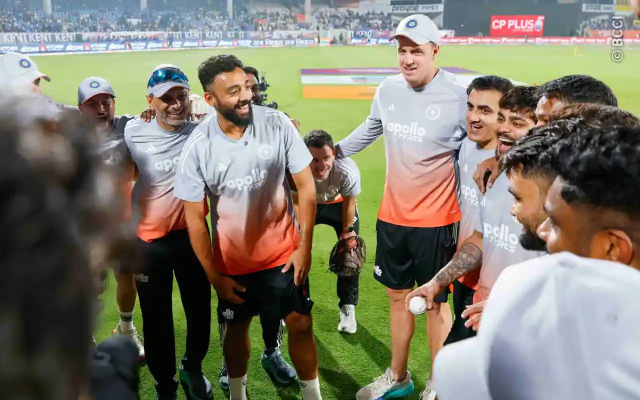
His presence has added another cushion to the batting line-up, and with the newest experiment of him at number four, Rinku can be floated both as a proven finisher and in the top order. Shivam Dube, too, has come good with his finishing abilities. In the fourth T20I last night, the all-rounder was hitting around the park at a strike-rate of almost 300.
When it comes to the bowling department, it will be led by the evergreen Jasprit Bumrah, with Arshdeep Singh and Harshit Rana as the support cast. Both have found breakthroughs throughout the series, even if they have been expensive at times. Harshit also added an extra dimension to his skill set with an impressive 52 (43) in the third ODI, proving that, when needed, he can contribute runs to the scoreboard as well.
In the absence of Washington Sundar, who was ruled out of the series due to injury, Ravi Bishnoi was called up. In the two games he has played so far, he has picked up three wickets. Kuldeep Yadav has not been at his best of late, yet remains a crucial part of the set-up alongside Varun Chakravarthy and Axar Patel, who are sure-shot starters in the playing XI.
Now, even though a few questions remain – particularly around Samson’s form and Kishan’s place in the XI once Tilak returns – this Indian side will walk into the T20 World Cup without a single “cemented” combination. Instead, they have something that many don’t possess: flexibility. The 15-member squad has been firing as a unit, giving the management the freedom to pick horses for courses and tailor the XI to conditions and match-ups.
This Indian management, with Gambhir at the helm, has embraced the philosophy of controlled chaos – a system where roles are fluid and impact is king. Which is precisely why, no matter which XI you pick out of the 15, it always looks like a full-strength team. So, if the question is, “Is India’s playing XI settled?” the answer is simple: it doesn’t need to be.
For More Exciting Articles: Follow RevSportz