




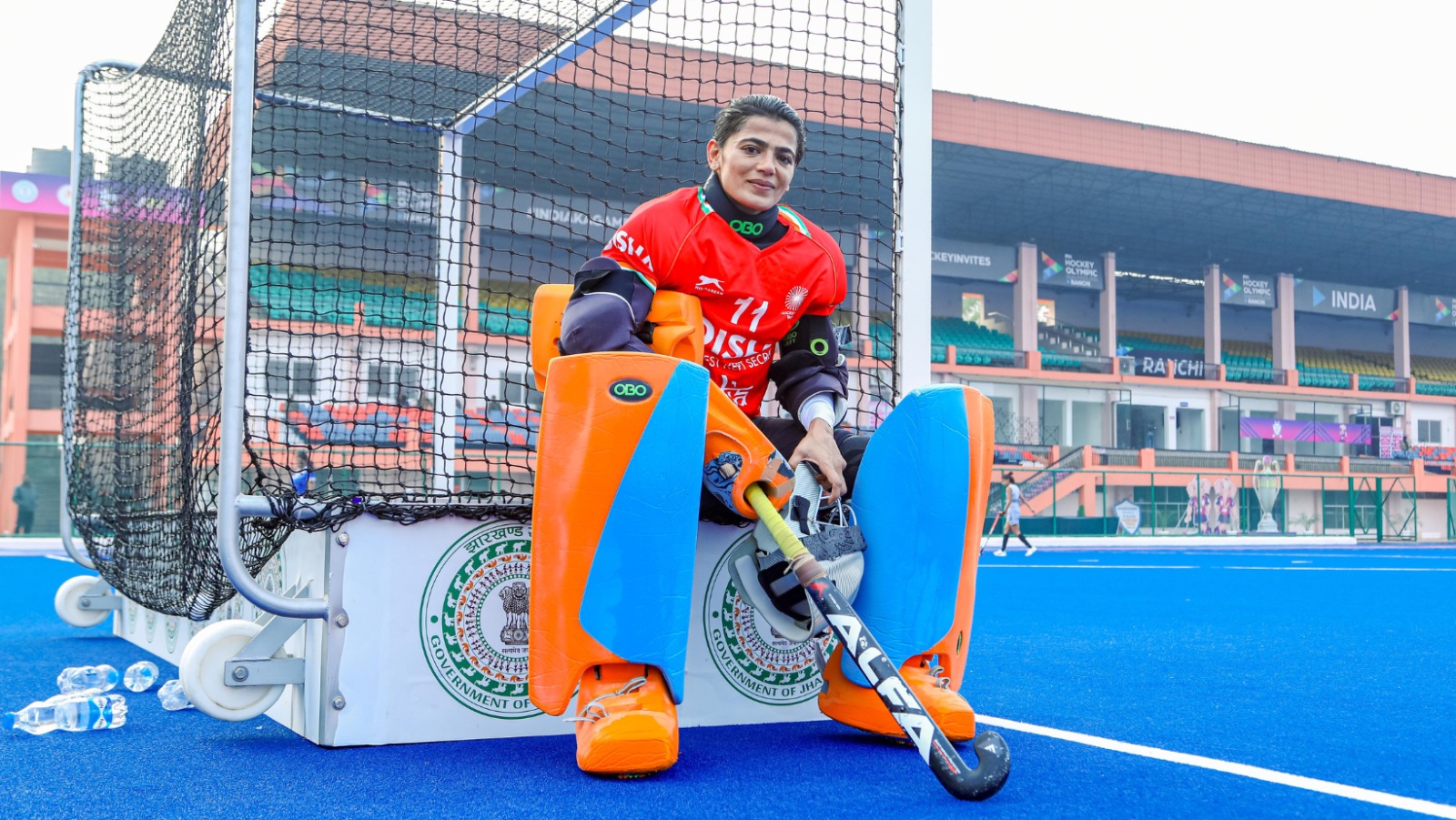
If there’s anything we learn from Savita Punia, one of the finest goalkeepers produced by Indian hockey, it is to never give up. The sport and unfortunate circumstances in life handed her reason after reason to quit, but Savita never stopped trying. Today, she has been honoured with India’s fourth-highest civilian award, the Padma Shri. In an exclusive interview with RevSportz, an emotional Savita looks back on her journey – the ebbs and flows – and the dream ahead.
Q: What was running through your mind when you got the phone call that you had been honoured with the Padma Shri?
To be honest, I still can’t believe this has happened. I had waited a long time, but I always believed in my work. I kept telling myself that I just had to keep doing my job and maybe one day it would happen.
The phone call I got yesterday was from my dad. When my brother filled out the application, he always gave my dad’s number because most of the time my phone is on silent during training. So when I saw my dad calling, it was already a moment of joy for me. Even if he hadn’t called, my first call would have been to him. I just wanted to make him proud.
When he picked up the phone and said that he was talking to the ministry and that Savita Punia was getting this award, I was completely speechless. I honestly don’t know how to describe that happiness. But this journey belongs to so many people: my federation, Hockey India, SAI, my teammates, my coaching staff, and both my families.
When something good happens, you remember the entire journey. I think about my domestic coaches, the children I see every day at the ground, and the kids who come for trials. I always pray that their future should be in sports because they give so much time and effort.
I also know how much my parents supported me. Parents always have stress, though they never show it. There is always a worry that their child is giving so much time to sport and not enough to studies, and whether the child’s career will be secure. So I always pray that God gives every child a chance to perform and find motivation.
There have been many ups and downs in my life. But through everything, my biggest support has been my family. Whatever happens today and in the future, my family will always be my foundation. When you get such an award, you dedicate it to them, because I am here today only because of them.
Q: How did your dad convey the message in that phone call?
Oh my God, how do I tell you? When I picked up the phone, I jokingly said, “Namaste, Papa ji.” Then he replied, “I am talking to Padma Shri Savita Punia.” And I said, “Please don’t make fun of me.”
He said, “No beta, this time it’s true. It has really happened.” Suddenly, he became very emotional.
Seeing your parents cry, whether out of happiness or sadness, is very emotional. I also got emotional. I kept asking him, “Papa, are you telling the truth?” and he kept saying yes.
For a moment, it even felt unreal – like in the age of AI, whether this is real or not. But by God’s grace, this day finally came.
Q: From Hisar to Padma Shri. Looking back on your entire journey, what was your most difficult phase?
There have been many happy moments and many struggles. But the most difficult moment was when I stood at the Delhi bus stand, called my dad, and cried, saying I didn’t want to play hockey anymore.
I had my kit bag with me, and the conductor wouldn’t let me sit on the bus. He said I had to buy two tickets because of the luggage. Boys were laughing and making comments. I felt humiliated. I didn’t want to waste that extra money because I always wanted to save for my family. That day, I completely broke down.
My dad told me to somehow manage that day. Later, he bought a second-hand car so that I wouldn’t have to go through this again. That moment still motivates me today. When things go wrong, you feel like giving up. But when something good happens, those memories make you stronger.
Another difficult phase was being the second goalkeeper in the Indian team for five years. I was never sure when I would get a chance. Sometimes I would be selected, sometimes not. My dad always told me to be patient, to keep working hard, and be ready when the opportunity came.
I never thought about awards. For me, if my coach or my teammates say, “Savita, you are a good goalkeeper”, that itself is a big award. In 2019, when my coach told me I should be nominated for FIH Goalkeeper of the Year and said I was among the best three in the world, I became emotional. That validation meant everything. Later, I won that award three times.
All my coaches played a huge role in shaping me. My domestic coaches worked tirelessly on my basics. When my dad bought me my first kit for Rs 18,000, I cried because it was more than two months of his salary. My mother told me not to make my father sad and to just give my best.
Coming from a simple, middle-class family in Haryana, where there is still a difference between boys and girls, I felt I was being given more importance than my brother. That itself motivated me.
Another very tough moment was in 2013, when I was about to get my chance as first goalkeeper. Just two weeks before that, my grandfather passed away. He was the reason I chose hockey. My parents told me his blessings were with me and that I should take this opportunity as his gift. Even today, I keep his photo on my phone and dedicate my entire hockey journey to him.
Q: You used to say that goalkeepers were only made accidentally, but after the Tokyo Olympics, many young girls started wanting to become goalkeepers because of you. How does that feel?
I feel extremely blessed. I can’t believe that the girl who once feared stepping out of the house has today become an example for others.
After Tokyo, when parents came to my house with their daughters, I felt so happy. I always wanted every girl to get the same respect and freedom that my parents gave me. There cannot be anything more fulfilling than this.
After marriage, I am also thankful to my husband and my in-laws for letting me continue my career. In India, it is rare for married women to get this kind of support. My family is my strength. If they hadn’t supported me, I would have left hockey long ago.
Q: During the Tokyo quarter-final against Australia, you stood like a wall. What was going through your mind?
After Rio, I told myself that I could not end my career like this. I wanted to play another Olympics and contribute something meaningful to my team. I worked very hard, not just physically but mentally, to handle pressure.
Before the match, I called my dad and told him that Australia was world number one and that we were underdogs. He reminded me of all the training I had done in the heat and all the sacrifices. I told him confidently that we would win.
Standing at the goalpost, I was enjoying every moment, even though there was immense pressure. When only a few minutes were left, I wanted to celebrate because our dream of reaching the top four at the Olympics was coming true. That match gave motivation not just to us, but also to young players watching across the country.
Q: How important is coach Sjoerd Marijne’s return?
It is very important. He brings passion, discipline, and high standards. He challenges players, sets clear goals, and creates a very healthy and energetic environment. When coaches, trainers, and staff work together like this, it motivates everyone to give their best. Every coach is passionate, but the passion that Sjoerd has for Indian hockey is unmatched.
Q: Yesterday, the Padma Shri, today this interview. What is your dream for the future?
There was a time when I almost gave up after we failed to qualify. My family and husband supported me, and people like Mr Boria Majumdar motivated me deeply. He spoke to me for an hour and motivated me. He told me, “I am not going to let Savita Punia end like this.” He shared stories of Sachin Tendulkar – how after a World Cup loss, he locked himself in his room for four days and decided to start working hard again. That helped me regain belief. From there, I restarted my journey.
My dream is simple: to keep giving my best for Indian hockey and to never quit on myself.