





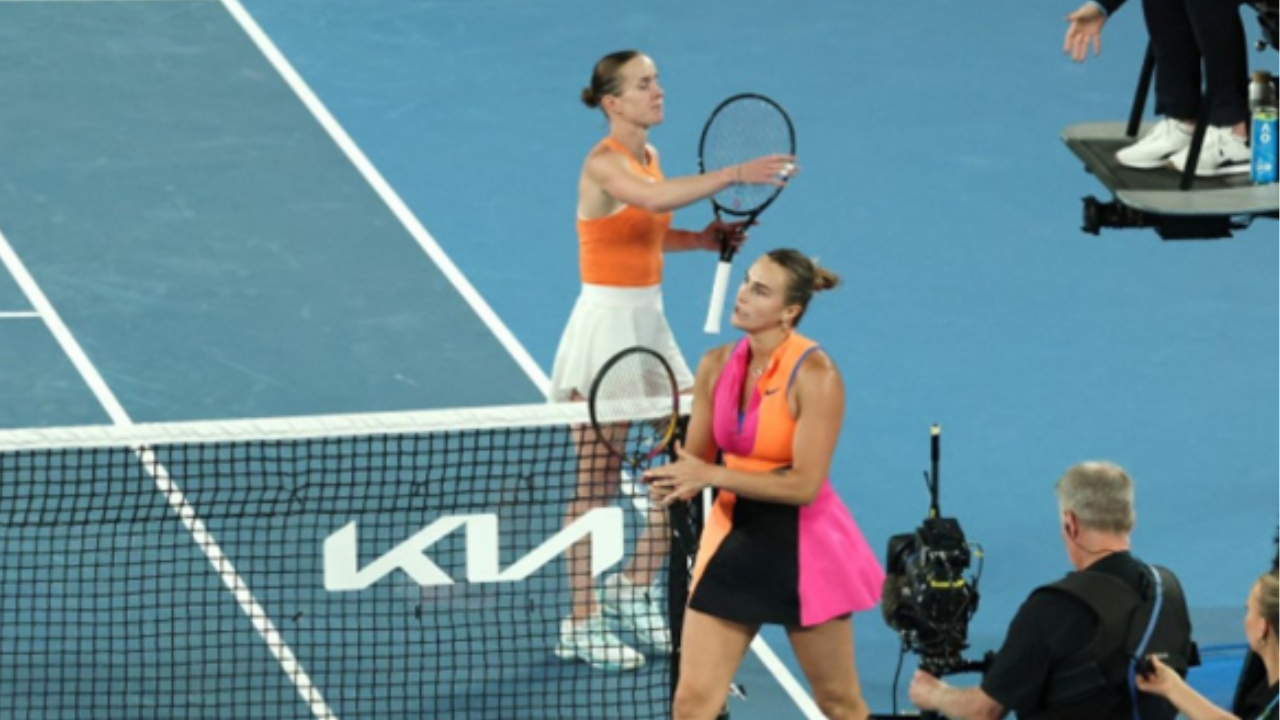
At the Australian Open, the tournament did something quietly radical. When Aryna Sabalenka, a Belarusian, stepped onto the court knowing her Ukrainian opponent would refuse to shake hands, there was no outrage. No lectures on ‘the spirit of sport’. No talk of decorum. Instead, the tournament calmly put it out there to prepare the crowd. The moment was framed as empathy, not insolence.
Contrast this with cricket. When Indian players choose not to shake hands with Pakistani players at the Asia Cup, the same global ecosystem suddenly discovers a deep attachment to sportsmanship. Commentators talk about ‘setting a bad example’. Administrators urge ‘separating sport from politics’. Social media becomes a sermon on civility. It is the same act, same symbolism but opposite judgement. Why? Isn’t this selective and convenient morality?
Ukraine vs Belarus is framed as a moral clarity match-up. The narrative is already written. There is a villain, a victim, and a globally sanctioned emotion. So refusal to shake hands is not seen as defiance; it is seen as solidarity.
India vs Pakistan, however, is geopolitically inconvenient. There is no globally agreed script. No clean hero-villain arc. Just two post-colonial nations with unfinished history, layered trauma, and unresolved borders. That ambiguity makes sport’s administrators uncomfortable. Not because it is wrong, but because it does not fit the brochure.
So instead of calling it what it is — political expression through cultural ritual — the system chooses a softer word ‘poor sportsmanship’. This is ironic because the same system monetises the very tension it pretends to dislike.
We pretend sport is neutral. It never has been. The Cold War Olympics were ideological battlegrounds. The Falklands War was replayed through Maradona’s ‘Hand of God’ act. Serbia vs Croatia is still political. Iran vs USA is diplomatic theatre. Ukraine vs Russia is moral symbolism. All of these are celebrated as ‘sport reflecting society’. But when South Asia does it, it is told to grow up.
What the Australian Open did knowingly or not was expose the lie. By pre-emptively explaining why a handshake would not happen, the tournament did not remove politics from sport. It curated it. It framed dissent as context. It managed emotion instead of suppressing it. The problem is not that India-Pakistan carries political meaning and still pretends it doesn’t know what to do with it.
If sport is going to be the world’s most powerful emotional stage, then it needs a system to manage political symbolism instead of pretending it does not exist. Is it time then to define a futuristic protocol for this ?
Tournaments must formally declare when a fixture has geopolitical sensitivity and provide official context — not propaganda, but framing. Teams and athletes may declare in advance if they will avoid handshakes, flags, anthems or ceremonies. If a rivalry drives more than 25% of a tournament’s value, the organisers must acknowledge that the emotional tension is part of the product. Athletes are not diplomats, but they are not furniture either. Their bodies, gestures and silences are messages and must be respected as such.
In 1945, George Orwell said that sport is war minus the shooting. In 2026, is it now time to say that sport gives nations a language that can complement political diplomacy? Food for thought?
Also Read: Is Australian Open witnessing the first real data rights revolt in modern tennis?